

Why is my wall or floor still damp after I dried the water?
Mopping and fans remove the water you can see. The moisture that soaked into drywall, framing and subfloor stays behind and keeps affecting the structure. The trade name for removing it is structural drying, and it is a measured process rather than an open window and a fan.
This page explains structural drying and dehumidification, which also include the process people sometimes call water mitigation. The steps below show what equipment is used and how crews know when a building is dry.
How structural drying works
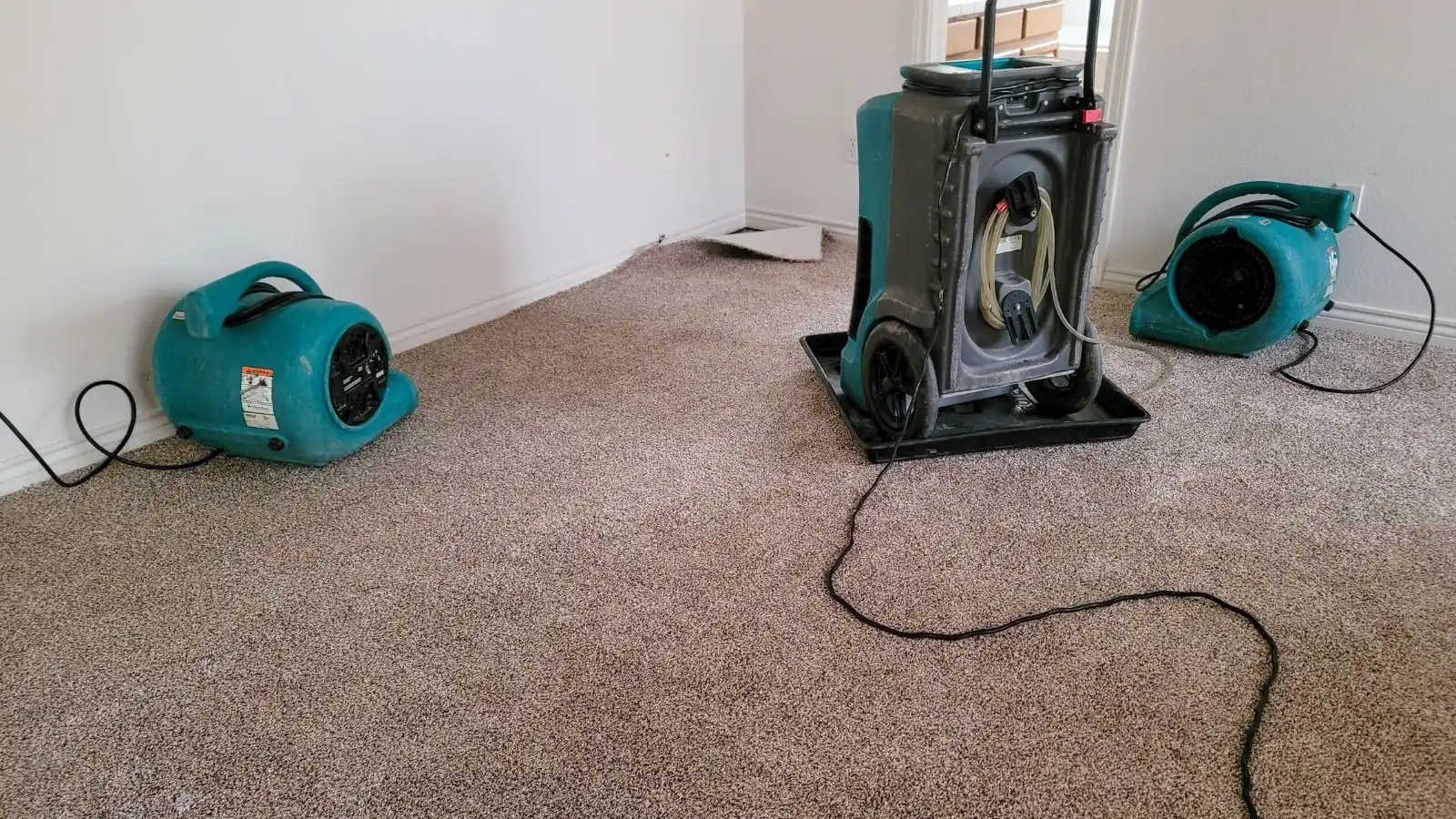
Wet materials release moisture into the air when warm, dry air moves across them. That moisture has to be removed from the air or the room will stay humid, which is why airflow and dehumidification run together. Air movers push air across wet surfaces, and dehumidifiers pull the moisture out of the air.
Crews first map the moisture with a moisture meter and a thermal imaging camera, then record temperature and humidity readings of the room and of the equipment. Those psychrometric readings tell them how much drying capacity the room needs, and they repeat the readings daily.
Air movers
Fans that blow air across wet floors and wall bases. Placement follows the wet areas, and crews move them as readings change.
LGR dehumidifiers
Low-grain refrigerant units that remove moisture from the air even in cooler rooms. They run closed with doors shut so that the moisture stays in the drying space.
Floor drying mats
Mats that pull moisture out of hardwood and subfloor with suction.
Moisture meters and thermal cameras
Tools for finding wet areas and tracking dry-down. Pin meters read depth, and pinless meters scan surfaces.
Water mitigation and drying: what the term covers
Water mitigation is the work done to stop the loss from growing. It includes stopping the source, removing standing water, removing materials that cannot be dried and setting drying equipment. Drying is the part that continues for several days after the first visit.
The industry standard ANSI/IICRC S500 describes the principles of water damage restoration and is the reference crews use for drying goals. Ask any company you hire whether its crews work to it.
Drying goals and daily monitoring
A drying goal is the moisture level that the same material reaches in an unaffected part of the building. Crews take readings on affected materials and compare them with that dry standard. When each material reaches it, the equipment comes out.
Crews return every day to check readings and adjust the equipment. Some materials dry in two or three days, and others, such as plaster, thick wood and concrete, take longer. If readings stop falling, something is feeding the moisture, and the crew looks for a hidden source.
| Material | Typical drying approach | Notes |
|---|---|---|
| Drywall | Air movers, dehumidifier, sometimes cut open at the base | Soaked drywall may be replaced |
| Hardwood floors | Drying mats and dehumidification | Speed matters because boards cup |
| Carpet over pad | Extract, lift, dry in place or replace pad | Depends on water category |
| Subfloor and framing | Directed airflow and dehumidifier | Dry before closing walls |
| Concrete | Dehumidification and time | Slow to release moisture |
The actual approach depends on readings from each material.
Rooms still damp days after the leak? Call and describe what you feel and smell.
☎ Call (740) 231-9132Safety around drying equipment
Keep these in mind while you wait for help.
- Do not unplug or move equipment on your own.
- Keep children and pets away from cords and machines.
- Report any tripped breaker to the crew.
Equipment questions callers often ask
Callers sometimes ask whether they can rent air movers and dehumidifiers to dry a room themselves. Rentals are not offered here, because drying only works when equipment is placed against readings and checked daily. A fan in a closed room can raise humidity and make the problem worse.
Drying time depends on the material, the amount of water and the weather. In the Athens valley, humid summer weather slows drying without a dehumidifier, so crews run it closed.
What happens if you skip proper drying
Materials that stay damp can swell, warp, stain and smell. Paint can bubble and trim can separate. Hardwood can cup or crack, and subflooring can soften. Damp materials also keep moisture available, which is the first thing mold needs. Mold work is a separate trade and is not covered on this page, so ask whether your state licenses mold work if you see growth.
The hardwood floor page and the wall and drywall page describe how specific materials respond to drying.
What affects the cost of drying
Drying is priced from the amount of wet material and the time it takes.
| Factor | Why it changes the scope |
|---|---|
| Area and volume | More wet material needs more equipment. |
| Materials | Dense materials dry slowly. |
| Number of days | Each day adds monitoring and equipment time. |
| Room layout | Closed rooms and tight spaces need more setup. |
| Water category | Contaminated water may require removal before drying. |
You decide after hearing the scope and price. Call (740) 231-9132 and tell the dispatcher what is wet.
Frequently asked questions
Why does my house still smell damp after I mopped up the water?
A damp smell usually means moisture remains in the carpet pad, drywall or subfloor. Surface mopping does not dry those materials. A moisture meter finds where it is, and drying equipment removes it.
How long does structural drying take?
Often three to five days for a typical room, though the time depends on the material, the amount of water and the humidity. Crews decide by daily readings.
Can I rent a dehumidifier and a fan myself?
Equipment rental is not offered here. Drying works best when equipment is placed and monitored against readings.
What is an LGR dehumidifier?
A low-grain refrigerant dehumidifier removes more moisture from air than a household unit and works at lower temperatures.
How do you know when the building is dry?
Readings on affected materials match readings on similar unaffected materials. Crews compare them daily.